









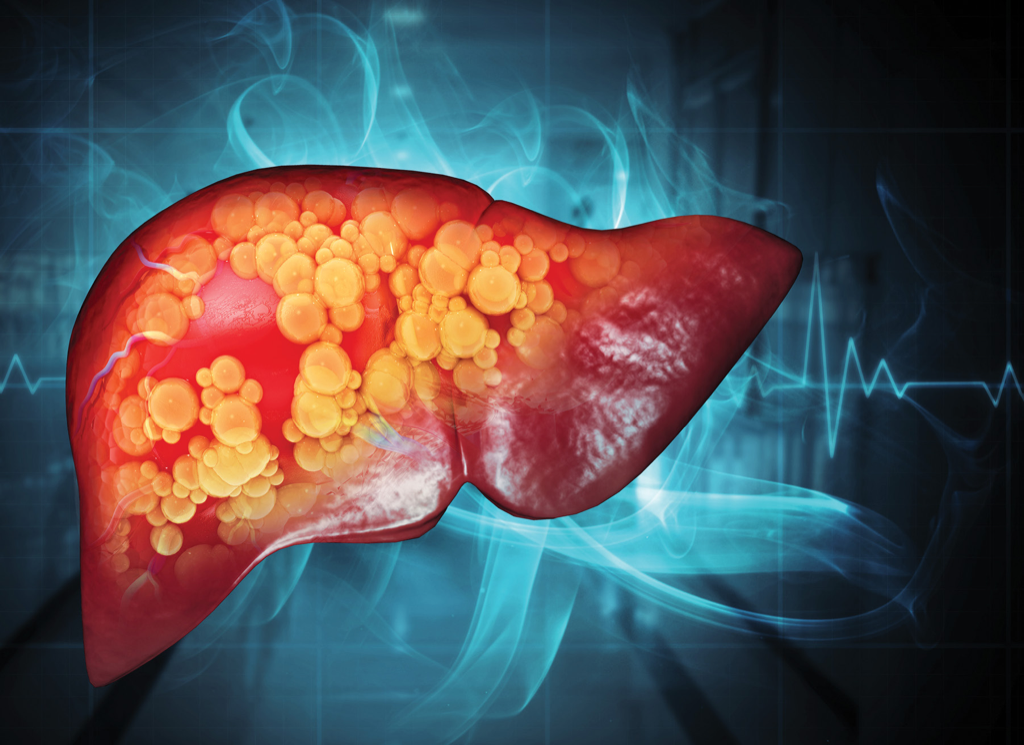
Metabolic dysfunction-associated steatotic liver disease is closely intertwined with obesity, type 2 diabetes, dyslipidaemia, and cardiovascular disease. Greater emphasis on fibrosis risk, non-invasive assessment, weight management, and emerging pharmacological therapies is changing clinical practice and placing the liver firmly within the wider management of cardiometabolic disease.¹,²
Metabolic dysfunction-associated steatotic liver disease (MASLD), formerly termed non-alcoholic fatty liver disease (NAFLD), is increasingly recognised as a major component of cardiometabolic disease rather than an isolated hepatic disorder. It encompasses hepatic steatosis occurring in the presence of at least one cardiometabolic risk factor and includes a spectrum ranging from steatosis to metabolic dysfunction-associated steatohepatitis (MASH), progressive fibrosis, cirrhosis, and hepatocellular carcinoma.¹
Its relationship with obesity and type 2 diabetes (T2D) is particularly important. Excess adiposity, insulin resistance, dyslipidaemia, and metabolic dysfunction contribute to hepatic fat accumulation and disease progression, while the presence of T2D increases the likelihood of advanced liver disease.¹,²
For endocrinologists and other clinicians managing metabolic disease, the implication is increasingly clear: liver risk should form part of cardiometabolic assessment.
Fibrosis determines risk
The presence of hepatic steatosis alone does not adequately identify patients most likely to experience adverse liver outcomes. Fibrosis severity is one of the strongest determinants of prognosis, making identification of patients with advanced fibrosis a central objective of contemporary MASLD management.¹
This presents a practical challenge because MASLD may remain clinically silent for many years. Liver enzyme concentrations can be misleading, and normal aminotransferase levels do not reliably exclude clinically important fibrosis.¹,²
Current guidance consequently favours risk-based case finding rather than relying on abnormal liver enzymes alone. Patients with T2D, abdominal obesity accompanied by additional metabolic risk factors, or persistently elevated liver enzymes represent particularly important groups in whom MASLD and advanced fibrosis should be considered.¹
The objective is not necessarily to identify every individual with hepatic steatosis. Rather, clinicians need to identify the smaller proportion at risk of progressive fibrosis, cirrhosis, and liver-related complications.
Non-invasive assessment changes practice
Liver biopsy remains important in selected circumstances, but it is invasive and unsuitable as a population-level screening strategy. Non-invasive tests have therefore assumed a much greater role.
The fibrosis-4 index (FIB-4), calculated using age, aminotransferase concentrations, and platelet count, is widely recommended as an initial assessment in patients at risk.¹,² A low FIB-4 score can help identify individuals with a low probability of advanced fibrosis, while an elevated or indeterminate result should generally prompt secondary assessment.
Second-line assessment may include vibration-controlled transient elastography or other validated tests of liver stiffness and fibrosis.¹ Patients with findings suggesting advanced fibrosis require specialist evaluation and appropriate surveillance.
This sequential approach has particular relevance in diabetes care. The 2026 American Diabetes Association (ADA) Standards recommend that adults with T2D or prediabetes, particularly those with overweight or obesity, be assessed for MASLD-related fibrosis risk using non-invasive strategies.²
The increasing use of these tools allows fibrosis risk to be incorporated into routine metabolic care without requiring every patient to undergo imaging, biopsy, or specialist referral.
Weight loss remains fundamental
Lifestyle intervention remains central to MASLD management because improvement in the metabolic drivers of disease can improve hepatic and wider cardiometabolic health.¹,²
Weight reduction is particularly important. The 2024 EASL-EASD-EASO guideline recommends dietary and behavioural modification to improve liver injury, with the magnitude of benefit increasing as greater sustained weight loss is achieved.¹ Physical activity should accompany nutritional intervention because of its effects on cardiometabolic fitness and liver health, even when substantial weight loss is not achieved.
The 2026 ADA Standards similarly recommend an interprofessional approach to lifestyle modification in people with T2D or prediabetes, overweight or obesity, and MASLD, aiming for weight loss and increased physical activity for cardiometabolic benefit and improvement in liver disease.²
The challenge, as with obesity management more broadly, is maintaining weight reduction over time. Treatment therefore needs to recognise obesity as a chronic disease rather than presenting lifestyle modification as a short-term prescription.
Metabolic treatment becomes liver treatment
One of the most important developments in MASLD is the growing evidence that therapies used primarily in metabolic medicine can also influence hepatic disease.
The phase 3 ESSENCE trial investigated once-weekly semaglutide 2.4mg in patients with biopsy-defined MASH and moderate or advanced fibrosis. At week 72, resolution of steatohepatitis without worsening of fibrosis occurred significantly more frequently with semaglutide than placebo. Improvement in liver fibrosis without worsening of steatohepatitis was also significantly more frequent with semaglutide.³
The relevance to endocrinology is substantial. GLP-1 receptor agonists are already central to the management of T2D and obesity in appropriately selected patients. Evidence of histological benefit in MASH further illustrates how treatment directed at metabolic dysfunction can affect disease across multiple organ systems.²,³
The 2026 ADA Standards now recommend considering a GLP-1 receptor agonist with demonstrated benefit in MASH in adults with T2D, MASLD, and overweight or obesity. In patients with T2D and biopsy-proven MASH or a high risk of fibrosis, a GLP-1 RA is preferred for glycaemic management because of its beneficial effects on MASH.²
Dual agonism extends the evidence
Tirzepatide has also generated important evidence.
In the phase 2 SYNERGY-NASH trial, 190 participants with biopsy-confirmed MASH and stage F2 or F3 fibrosis were assigned to tirzepatide at 5mg, 10mg, or 15mg, or placebo for 52 weeks. Resolution of MASH without worsening of fibrosis occurred in 44%, 56%, and 62% of participants receiving the respective tirzepatide doses compared with 10% receiving placebo.⁴
Improvement of at least one fibrosis stage without worsening of MASH was also more frequent in the tirzepatide groups, although the investigators emphasised the need for larger and longer trials to establish longer-term efficacy and safety.⁴
These results are promising but should be interpreted according to the maturity of the evidence. Tirzepatide’s established metabolic indications should not automatically be conflated with a specific indication for MASH. Nevertheless, the findings reinforce the close biological relationship between adiposity, insulin resistance, and progressive liver disease.
A liver-directed therapy emerges
The therapeutic landscape changed further with resmetirom, a liver-directed thyroid hormone receptor beta-selective agonist.
In the phase 3 MAESTRO-NASH trial, patients with biopsy-confirmed steatohepatitis and fibrosis were randomised to resmetirom 80mg, resmetirom 100mg, or placebo. Both doses were superior to placebo for MASH resolution without worsening fibrosis and for improvement in fibrosis by at least one stage without worsening disease activity.⁵
MASH resolution occurred in 25.9% of participants receiving 80mg and 29.9% receiving 100mg compared with 9.7% receiving placebo. Fibrosis improvement occurred in 24.2% and 25.9%, respectively, compared with 14.2% with placebo.⁵
An additional finding of relevance to a cardiometabolic population was a reduction in low-density lipoprotein cholesterol with resmetirom.⁵
The emergence of liver-directed pharmacotherapy represents a significant change after years in which management relied predominantly on weight reduction, metabolic risk management, and treatment of associated conditions.
Cardiovascular risk cannot be ignored
Although progressive fibrosis and cirrhosis are important concerns, MASLD exists within a broader cardiometabolic risk environment. Cardiovascular disease remains a major determinant of morbidity and mortality in this population.¹
Management therefore cannot focus exclusively on the liver. Hypertension, dyslipidaemia, obesity, diabetes, smoking, chronic kidney disease, and established cardiovascular disease should be actively identified and treated according to contemporary recommendations.¹,² Statins should not be withheld merely because MASLD is present when lipid-lowering therapy is otherwise indicated.¹
This is particularly important because patients may perceive a diagnosis of fatty liver as a discrete hepatic problem. For clinicians, it should instead prompt consideration of the wider metabolic phenotype.
Multidisciplinary care becomes important
The changing treatment landscape also increases the need for collaboration between specialties.
Endocrinologists and primary care clinicians are well positioned to identify high-risk patients because obesity, T2D, hypertension, and dyslipidaemia frequently bring individuals into metabolic care before liver disease becomes clinically apparent. Hepatology input becomes increasingly important when non-invasive assessment suggests advanced fibrosis, when the diagnosis is uncertain, or when cirrhosis and its complications require specialist management.¹,²
Dietitians, diabetes educators, obesity specialists, cardiologists, and other healthcare professionals may also contribute according to the patient’s phenotype.
The aim is not simply to treat hepatic fat. It is to reduce the metabolic drivers of disease while identifying patients whose fibrosis places them at greatest liver-related risk.
Conclusion
MASLD exemplifies the increasingly interconnected nature of cardiometabolic disease. Obesity, insulin resistance, T2D, dyslipidaemia, cardiovascular disease, and progressive liver injury frequently coexist, making fragmented organ-specific management increasingly difficult to justify.¹,²
Contemporary care places greater emphasis on identifying fibrosis risk through non-invasive assessment, achieving sustained weight reduction, optimising cardiometabolic risk factors, and using therapies supported by emerging liver-specific evidence.¹,²,³
Recent trials of semaglutide, tirzepatide, and resmetirom demonstrate how rapidly the therapeutic landscape is changing.³,⁴,⁵
For endocrinologists, the central message is equally important: in patients with metabolic disease, the liver can no longer be regarded as a bystander. Identifying and managing MASLD is increasingly part of comprehensive cardiometabolic care.